
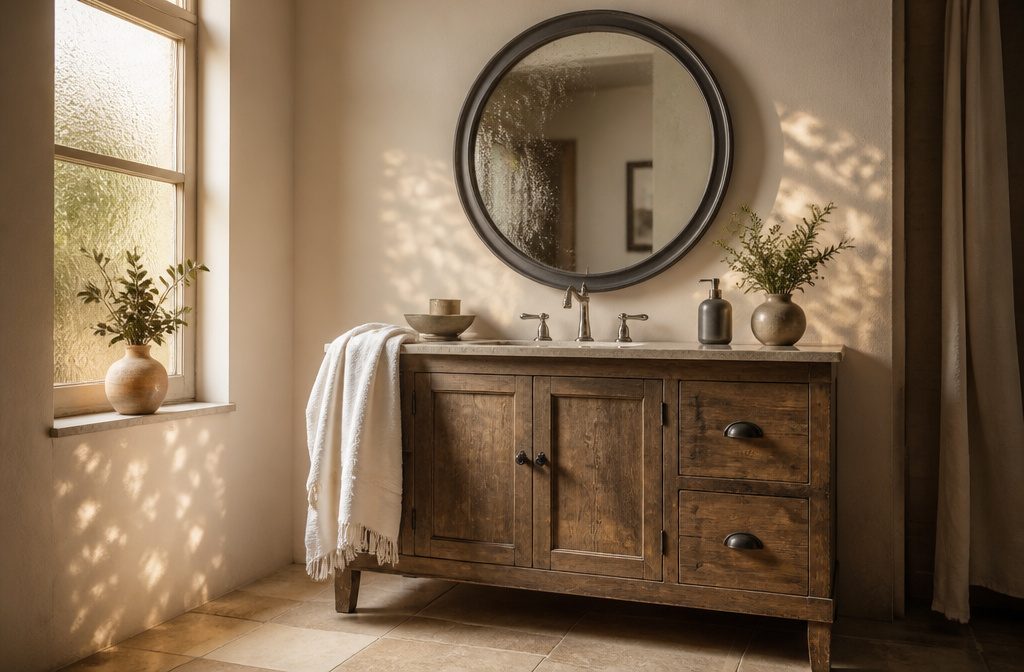

A bathroom mirror should be 2 to 4 inches narrower than the vanity below it, so a 24-inch vanity takes a mirror 20–22 inches wide.
A mirror as wide as the vanity can work, but the frame then sticks out past the edges. Measure to the frame’s outside edge: a 30-inch glass with a 2-inch frame takes 34 inches.
24-Inch Vanity Mirror
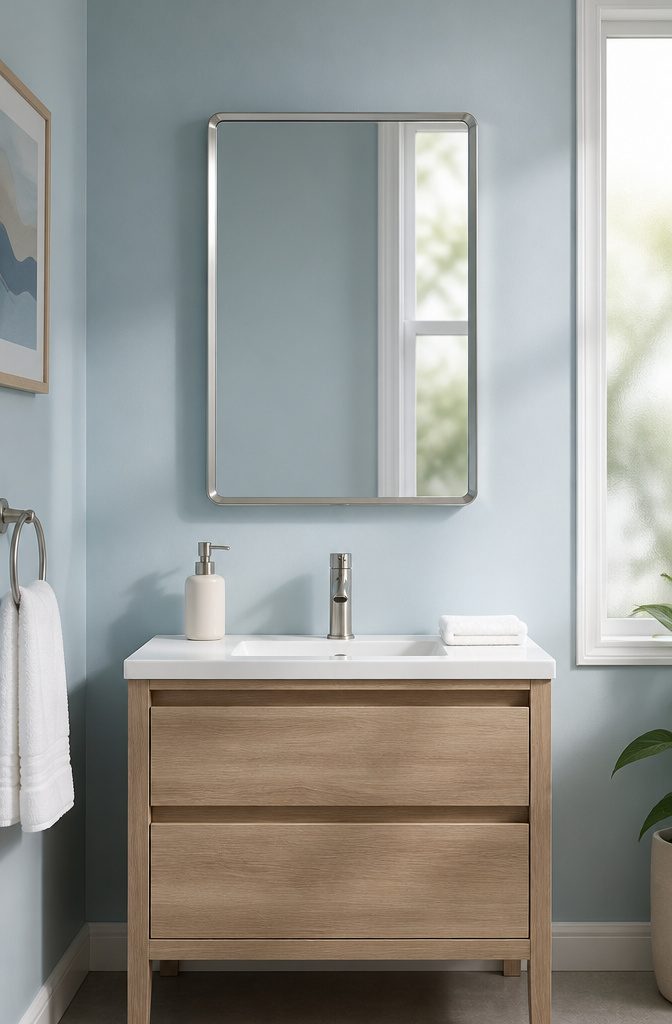
A bathroom mirror should be about 2 to 4 inches narrower than the vanity below it. For a 24-inch vanity, that means a mirror 20–22 inches wide.
Every size in this guide comes from that same rule. The narrower mirror leaves a little counter showing on each side, so the pair looks planned instead of squeezed together.
A mirror that matches the vanity width exactly can work, but I’d skip it on a small vanity.
You lose the breathing room, and any frame you add will stick out past the edges. Stay with 20–22 inches and a frame fits easily.
Before you order, check the vanity’s widest point and pick a mirror that sits inside it.
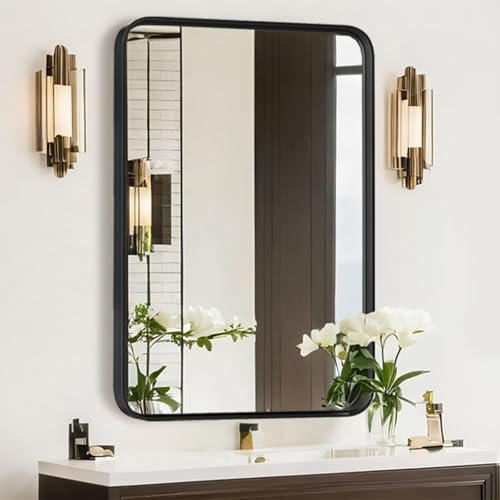
Clear Reflection & No Distortion: Utilizing advanced high-definition float glass, this bathroom vanity mirror delivers a sharp, distortion-free 1:1 image for an accurate and true-to-life reflection—perfect for use in a bathroom, vanity, or above the sink.

🌟【Sculpted Aluminum Frame with Layered Detail】This brushed nickel bathroom mirror features a thoughtfully crafted aluminum frame with a raised edge profile that creates subtle dimension and refined visual depth. The rustproof and moisture-resistant aluminum alloy ensures lasting durability in humid bathroom environments while adding a stylish finishing touch to your vanity wall décor.

The 3 inch wide frame has a sleek and clean white finish
30-Inch Vanity Mirror
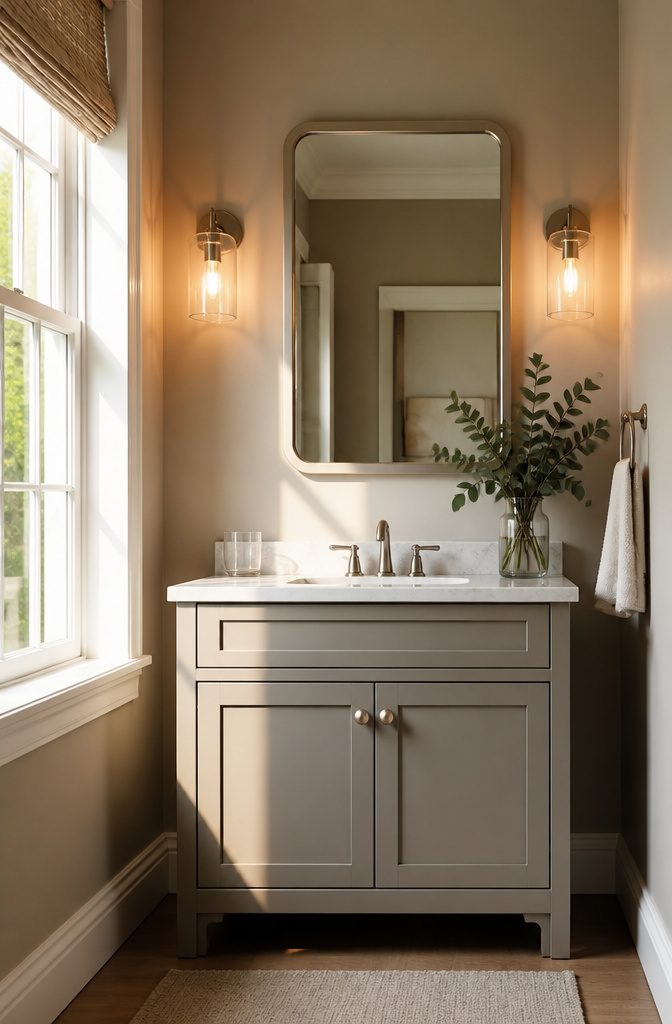
A 30-inch vanity looks best with a mirror that’s 26–28 inches wide.
That leaves a couple of inches of cabinet showing on each side, so the glass doesn’t crowd the walls. This is the classic guest bath setup, and one centered mirror is all it needs.
The standard 24" x 36" mirror is a little narrow here. It works, but it can look small over the cabinet.
The 30" x 36" is the other common size, and it runs the full width of the vanity. I’d only pick it for a deliberate wall-to-wall look with no side lights to fit.
If you want a mirror in between, look for one that’s 26–28 inches wide. Height is flexible, and 30–40 inches shows your head and shoulders well.
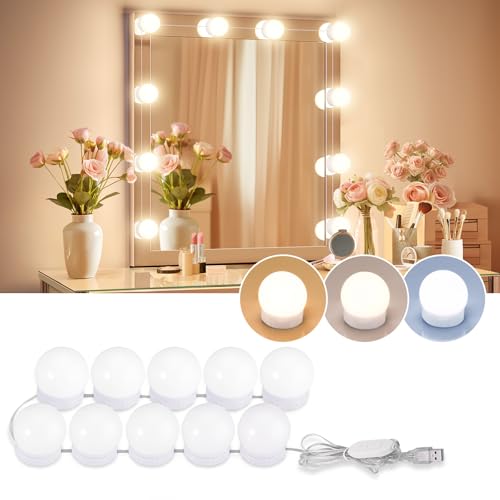
3 Color Tunable : Short press the button to choose the desired color temperature: Warm White (3000K) / Cool White (4000K) / Daylight (6500K). With 120 degree beam angle and sphere PC lampshade, our LED bulbs illuminates an even glow in any room of your choice
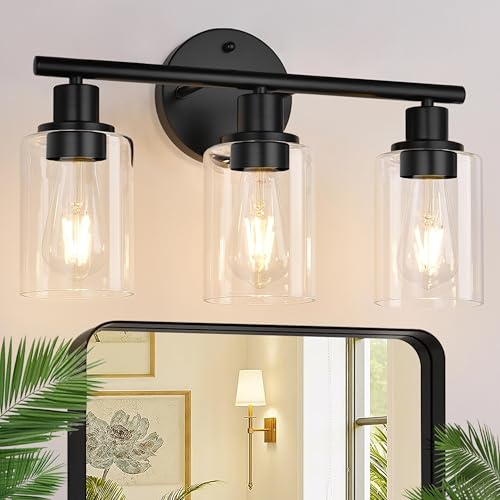
Upgraded Matte Black Finish: The vanity lighting fixtures feature a sleek matte black finish lamp body accompanied by clear glass shades. The upgraded finish not only adds an elegant touch but also includes a scratch and tarnish-resistant coating, ensuring that the black bathroom light maintains its pristine appearance over time. This exquisite bathroom vanity light is suitable for various decoration styles, making it the perfect choice to enhance your home lighting.

☞Perfect for Diy Glam Hollywood Style Vanity - If you have always wanted a Hollywood style vanity but not enough to spend hundreds of dollars on one. These led vanity mirror lights give you that look for next to nothing.
Mirror Size for a 36-Inch Vanity
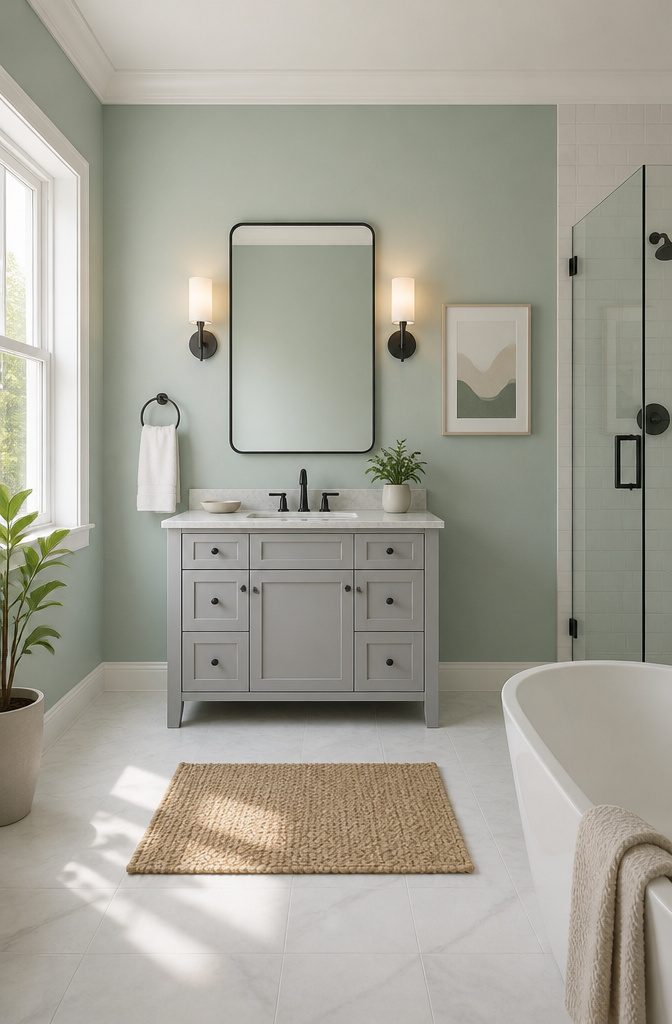
For a 36-inch vanity, aim for a mirror 30–34 inches wide. That keeps the glass a few inches narrower than the cabinet, which is the proportion that looks balanced.
A 30" x 36" mirror is a common fit.
At 30 inches wide, it leaves about 3 inches of vanity showing on each side. It looks full without crowding the walls.
A mirror as wide as the vanity can look squeezed in. If you want sconces (wall lights) beside the glass, stay on the narrower end so they have wall to land on.
Frames count too. A 30-inch glass with a 2-inch frame takes up 34 inches of wall, so measure to the outside edge before you buy.

Metric measurement: the height indicator tape ruler has 2 units of measurements, on the right side is a unit of measurement of 0 to 213 centimeter, on the left side is 0 to 83 inches, which can measure the height of most people; The width of each one is 1.8 inch

Acrylic Material: Made from premium acrylic, the growth chart mirror is safe, dependable, and offers clear reflection, ensuring a sturdy and aesthetically pleasing addition to any room.

Dual-Sided Magnification & Professional Lighting - Features an 8X6-inch rectangle double-sided mirror (1X normal view / 10X magnified) with 3-color adjustable LEDs (warm/neutral/cool) and stepless dimming, perfect for precise makeup, skincare, or shaving under ideal lighting.
48-Inch Vanity Mirror
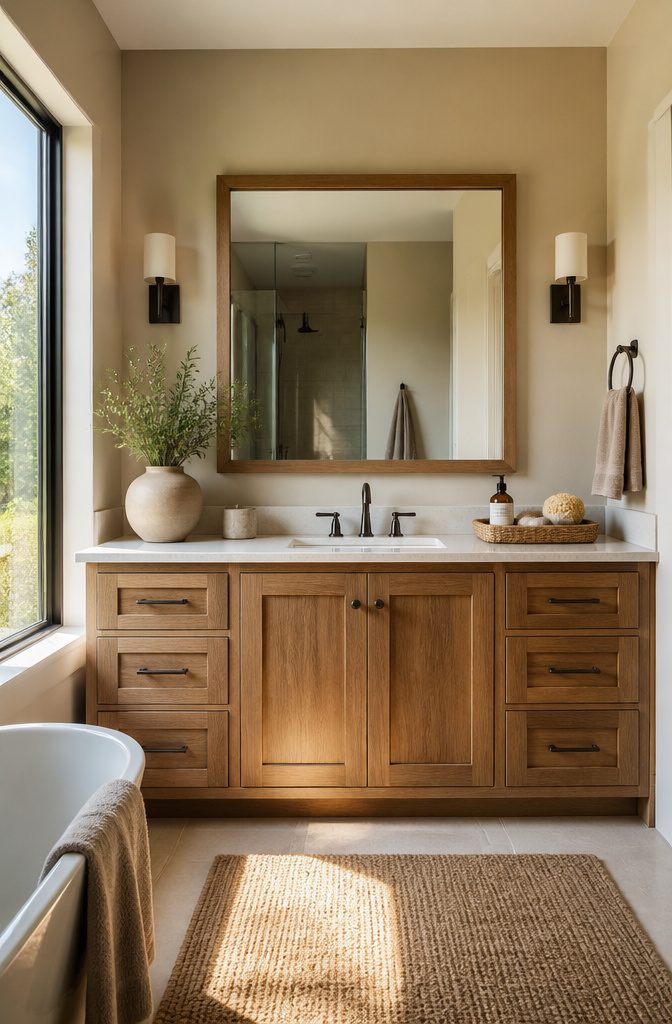
A 48-inch vanity looks best with a mirror 36–44 inches wide. That leaves a few inches of counter showing on each side, so the mirror sits inside the vanity instead of crowding its edges.
The two standard sizes are 48" x 36" and 36" x 48", width listed first. For a wide, single-sink vanity, I’d pick the 48" x 36" landscape version.
It follows the long line of the cabinet and gives you a broad view. The 36" x 48" portrait style is tall and narrow, so it suits a single sink best when the wall is short on width.
If you choose the 48-inch width, it runs flush with the vanity.
That works, but it gives the wall less breathing room. I’d stay a little under it.

Flawless HD Reflection: Experience a clear 1:1 reflection with our shatter-resistant tempered glass. It is much stronger than regular glass, ensuring safety and a distortion-free view for your daily grooming and makeup

【Clear Reflection & NO Distortion】: LOAAO bathroom vanity mirror is designed with HD float glass to deliver a clear reflection with no distortion; clear lines; simple modern design

HD Tempered Glass for Safety: DUMOS bathroom mirror features premium high-definition tempered glass, which is shatterproof and stronger than standard glass. It provides a 1:1 real reflection without distortion, ensuring a clear and safe visual experience
60-Inch Vanity Mirror
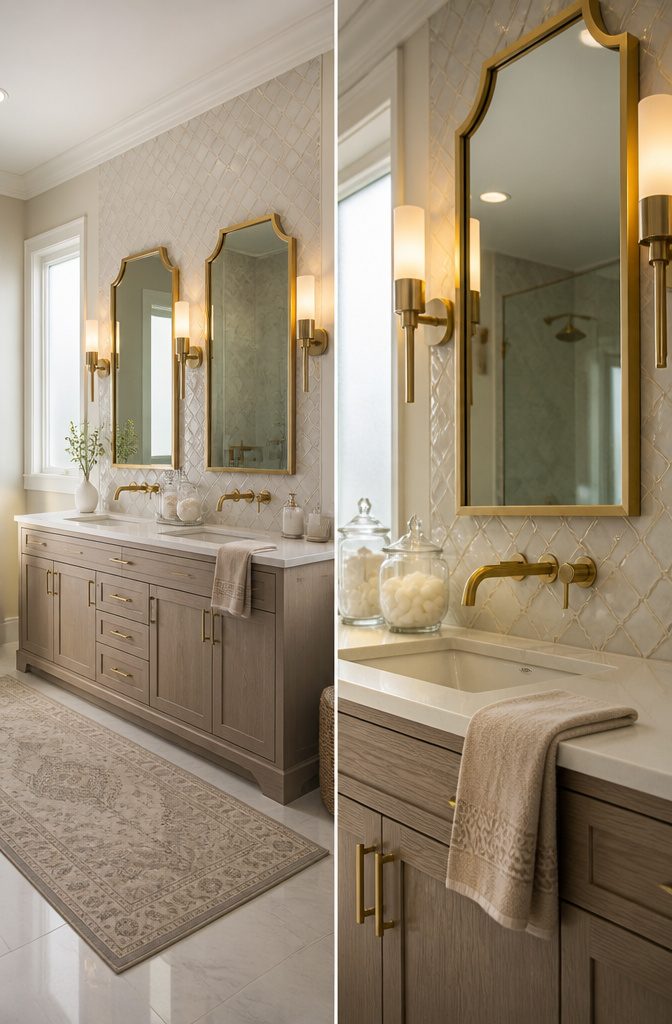
For a 60-inch vanity, pick a mirror 54–58 inches wide, or two mirrors at 26–28 inches each. That leaves a few inches of bare counter on each side, which looks intentional.
One wide mirror works best on a single-sink 60-inch vanity, or when you want a clean, frameless look.
Without a wall between sinks, though, you can’t hang a sconce there. You’ll need overhead light.
Over two sinks, I’d go with two mirrors. At 60 inches the sinks sit close together, and one big sheet of glass makes that tightness obvious.
Two mirrors give each person a spot. They also leave gaps for sconces, and you hang each one to its own sink, so a wall that’s a little crooked won’t show.

17.3-inch vanity light: Fits 24” and 30” standard bathroom mirrors—the top single-sink vanity sizes in homes. Well-proportioned and never too small or oversized, it delivers balanced, full coverage for your entire vanity area

【Eye-catching & Modern Design】- Advanced brushed gold texture coupled (high quality metal, anti-rust and won't fade) with transparent glass retro shade, showing a refined and modern style. It is suitable for wet places such as bathroom lights over mirror, laundry rooms, dining room, living room, corridor, cafe, basement, bar, club, office, library, and bedroom.

【Adjustable Brightness & Color Temperature】 Get ready to achieve flawless makeup application with our adjustable LED makeup lights. With 106 high color rendering light beads (Ra>90), you can adjust the color temperature and brightness to your liking with just a press of a button. The bright, non-dazzling light allows you to apply makeup for extended periods without eye strain.
72-Inch Vanity Mirror
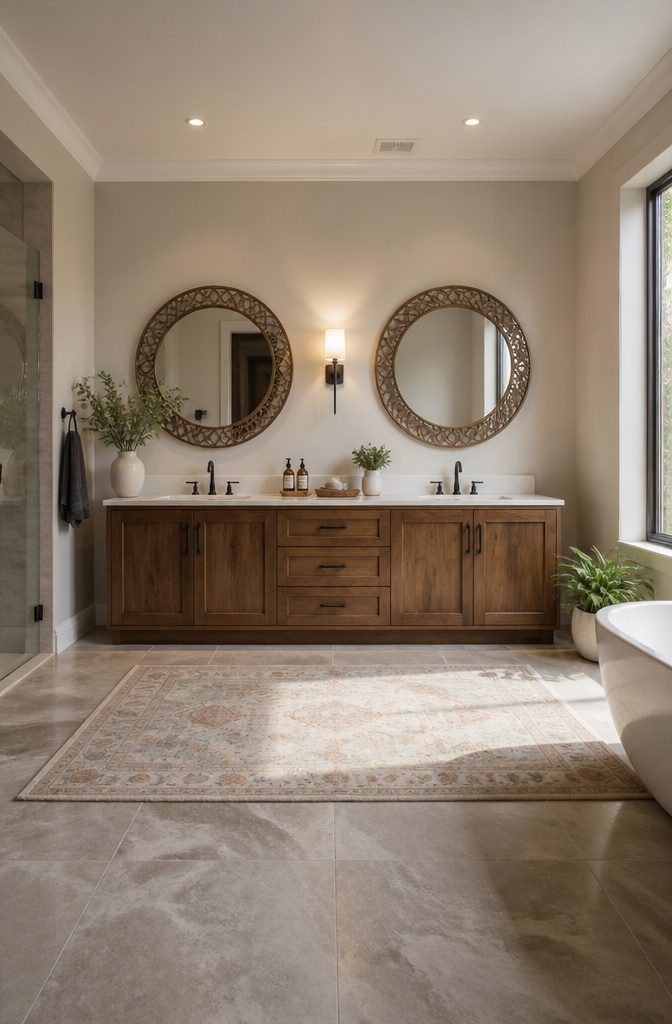
A 72-inch vanity is the one size where you get a real choice. A single mirror should run 66–70 inches wide, or you can hang two mirrors at 32–34 inches each.
Mirrors that wide are hard to find, and the few you do see tend to cost more and ship in oversized boxes. That alone pushes many people toward a pair.
I’d go with two. Each person gets their own spot at the sink, and two mirrors in the 28–32 inch range look more balanced over a wide vanity than one long slab.
Leave a few inches of wall between them. Round or oval shapes almost always look better as a pair, too.
At this width, add defogging and backlighting if your bathroom runs humid.
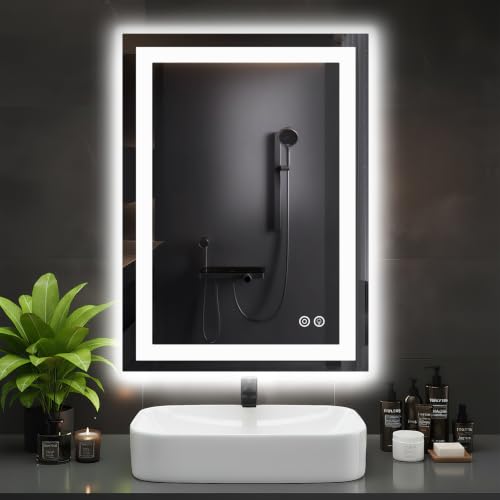
Anti-Fog Technology: This LED mirror clears fog from the center out, ensuring a clear reflection after showers. Central area stays clear while edges gradually defog, ensuring your reflection is instantly clear and ready for use

Premium Gold Perfume Mirror Tray:Features fine‑crafted metal border and smooth glass mirrored base, this gold vanity tray owns delicate hollow‑out metal edge, solid structure for long‑time daily use.

【Modern Elegance Meets Versatile Styles】 Embrace the modern sophistication of Keonjinn Rounded Metal Frame Mirror. With a clean rounded rectangular shape and subtle details such as a floating effect, the vanity mirror is meticulously designed to add a delicate touch to any decor in your bathroom, bedroom, living room, fireplace or entryway.
Mirror Height and Mounting
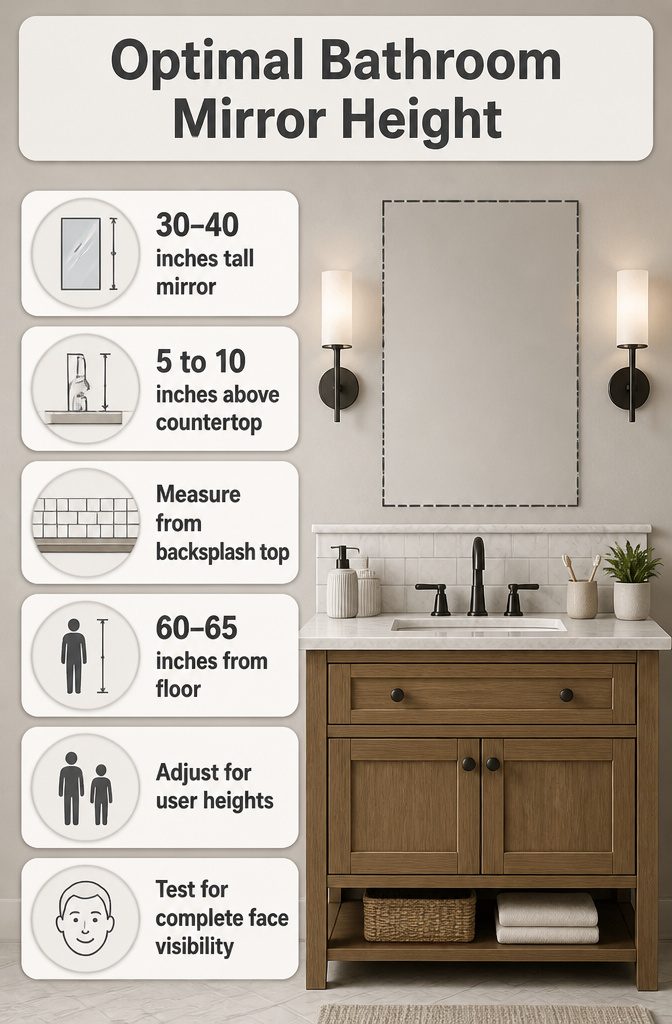
Two numbers decide how high to hang a mirror. Here’s how I’d set them:
- A mirror that’s 30–40 inches tall fits most vanities and works with the heights below.
- Keep the bottom edge 5 to 10 inches above the countertop. That clears the faucet, soap dispenser and toothbrush cup.
- With a backsplash, start measuring from its top, not the counter. Skipping this is the most common mistake.
- Aim for the mirror’s center at about 60–65 inches from the floor. That’s eye level for an average adult.
- In a home with tall and short users, split the difference or favor the person who uses the sink most.
- Test it: you should see your whole face without stooping or rising on your toes.

G25 LED Bulb With Even Lighting: The more uniform the light, the much easier for you to makeup quickly. The high light transmission lampshade and 80+ CRI of the G25 LED globe light bulbs allow the object looks closer to realistic. Visible flicker may result in eye-fatigue. However, the stable current of these mirror light bulbs provides you with a better lighting experience without flicker to protect your eyes.
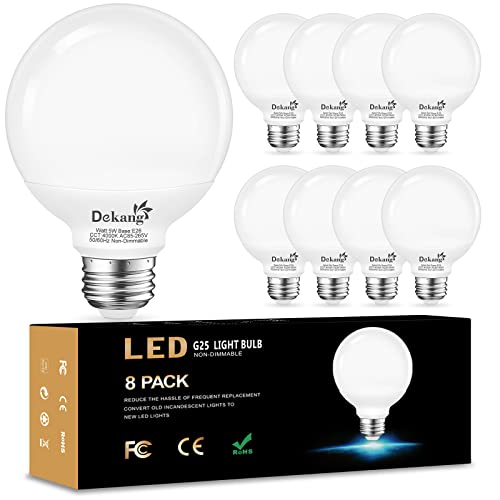
Vanity Light Bulbs 4000K Natural Daylight : 4000K natural daylight is the dividing line between 3000K warm light and 5000K Daylight white, which imitating natural light provides a lively and clean look, without appearing too blue or sterile. This natural light allows you to relax and stay awake. Suitable for light fixtures with E26 sockets like vanity mirror, dressing mirror. Appropriate for rooms like living rooms, bathrooms, kitchens, and other residential spaces.

Sleek Modern Aesthetics - Perfect for modern or farmhouse decor, our 4-light bathroom fixture pairs a matte black metal body with thick clear glass shades. This exquisite bathroom vanity light is suitable for various decoration styles, making it the perfect choice to enhance your home lighting. Product size: 23in L x 7in W x 11.56in H
Mirror Shape
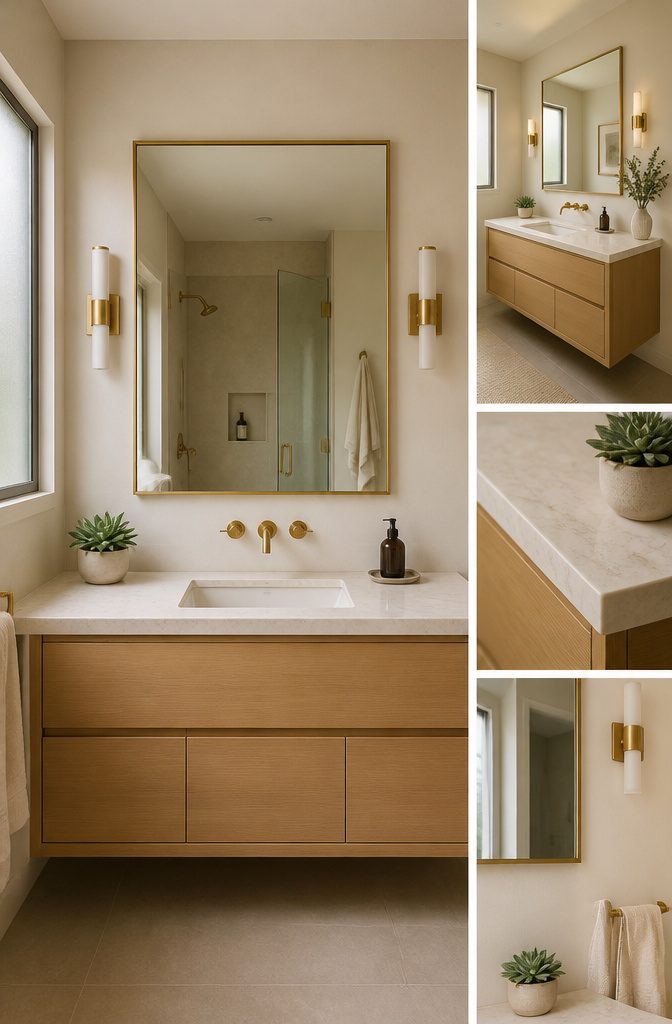
Rectangular is the safe pick, and I’d start there for most vanities.
It matches the straight lines of a countertop and cabinet, and you can use nearly the full width rule: a mirror around 70–80% of the vanity width, never wider than the vanity itself.
Round, oval and arched mirrors cost you some width. A round mirror’s diameter should be about the vanity width minus 4 inches, so a 26-inch round fits a 30-inch vanity.
Round softens a bathroom full of square tile and hard edges. A tall oval adds height in a low room.
Arched mirrors are flat at the bottom and curved on top, so size them like rectangles. They suit traditional and farmhouse rooms, but I’d skip them in a very minimalist space, where the arch can feel formal.

Wall Mount Mirror with Nickel Finish - Features retro decoration as well as corrosion resistance.

【9-inch Extra-Large Round Mirror & Dual Hooks】Experience a broader, clear view with the expansive 9-inch circular make up mirror. Two integrated hooks at the base offer convenient storage for your frequently used items, keeping them organized and within easy reach

Lighting That Feels Right, Morning or Night: Adjust the light to your preferred tone and brightness to create a more comfortable start to your morning or a relaxed wind-down at night
Lighting Beside the Mirror
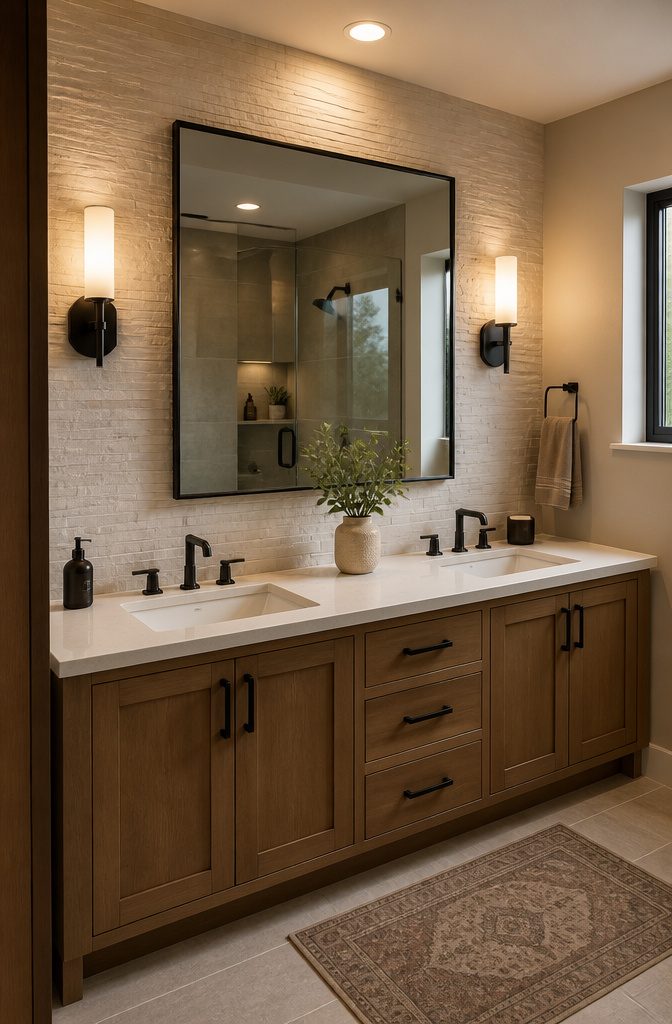
Sconces need wall space, and the mirror decides how much you get. Keep the glass inside the vanity width and the fixtures have a place to land on each side.
A mirror that runs wall to wall leaves no spot for them, so that look works only if you plan overhead light instead.
Mount sconces at eye level, which puts the light on your face instead of above it. A mirror’s center lands near 60–65 inches off the floor, so line the fixtures up around that height.
Measure to the outside of the frame, not the glass.
A frame adds roughly 1 to 3 inches per side, so a 30-inch glass with a 2-inch frame takes up 34 inches of wall. I’d tape the frame size on the wall first, then mark the sconces.

【Clear Reflection & NO Distortion】: LOAAO bathroom vanity mirror is designed with HD float glass to deliver a clear reflection with no distortion; clear lines; simple modern design
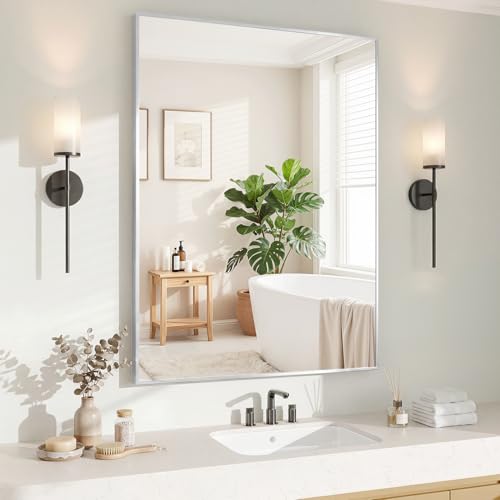
【Black Bathroom Mirror】: Koonmi Bathroom Mirror is made of HD glass and high quality silver aluminium alloy frame that is rust and corrosion resistant, and the back of the mirror is affixed with an explosion-proof film, which effectively prevents glass from splashing. This modern rectangular mirror comes in a classic brushed black finish and is suitable for a variety of home décor styles.

[PREMIUM STAINLESS STEEL 2-PACK SET] This gold metal tray set includes 2 pieces of durable stainless steel trays. Beautiful polished gold finish adds a touch of luxury, perfect for daily use and long-lasting performance without rust or deformation.
One Mirror or Two Over a Double Vanity
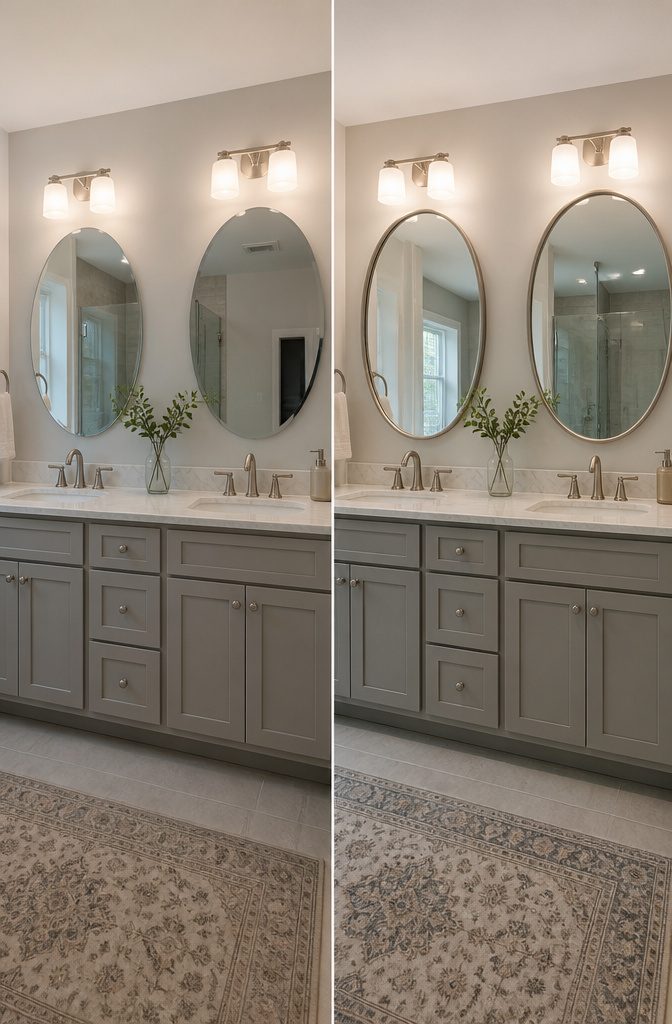
Both work on a double vanity, and the choice mostly comes down to lighting and looks.
One wide mirror feels clean and open. Two mirrors, one centered over each sink, give each person a station and leave a gap in the middle for a sconce (a wall light) at eye level.
I lean toward two mirrors on a 60-inch vanity, where one wide mirror makes the sinks look cramped.
On a 72-inch vanity, a pair at 28–32 inches each also looks more balanced. Round or oval shapes almost always look better as a pair.
Whichever you pick, keep the mirror no wider than the vanity. For one mirror on a 60-inch cabinet, 54–56 inches is common.
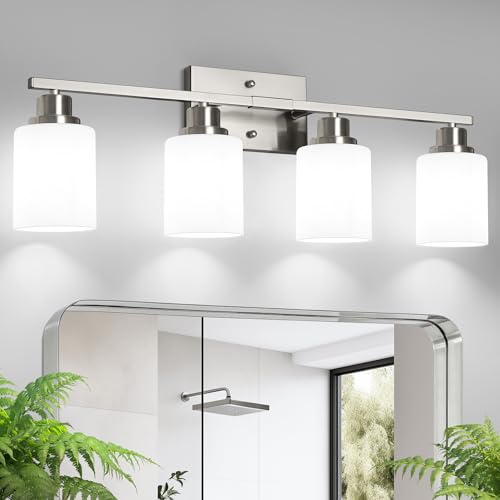
【Eye-Comforting Milky White Frosted Glass Shades】Tired of squinting under blinding vanity lights? Our vanity lights feature high-quality, milky white frosted glass lampshades that diffuse light evenly and eliminate harsh glare, creating a gentle, eye-caring illumination.
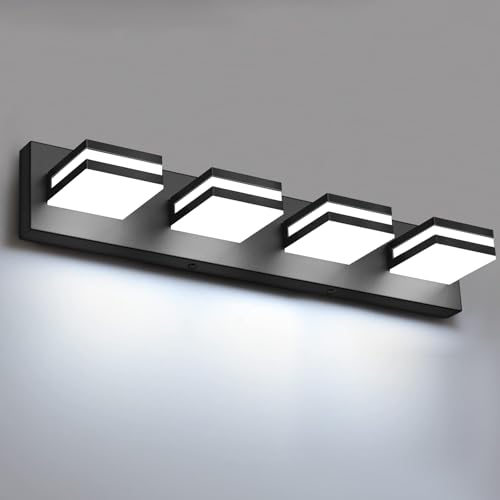
Modern Design : The 4-light bathroom light fixtures premium metal frame with frosted acrylic for glare-free diffusion and efficient heat dissipation, in a simple modern Matte black finish—perfect for home or commercial bathrooms

[Specialized Mirror Jewelry Cabinet] You deserve a better jewelry armoire with high quality and optimal structure for long-term usage. Each part of the design is designed for everyday use, so you won't have to bend over or squat too much to protect your joints
Frequently Asked Questions
What size mirror should I use for a 36-inch vanity?
Go with a mirror 30–34 inches wide.
That keeps the glass a few inches narrower than the cabinet, so some counter shows on each side. A 30" x 36" mirror is a common fit and leaves about 3 inches of vanity on each side.
How high should a bathroom mirror be hung above the vanity?
Keep the bottom edge 5 to 10 inches above the countertop, and measure from the top of the backsplash if you have one.
Then aim for the center of the mirror to land about 60–65 inches from the floor. That clears the faucet and puts the glass at eye level for an average adult.
Should a bathroom mirror be wider than the vanity?
No, a mirror a few inches narrower than the vanity looks more balanced.
Wall-to-wall glass only works as a deliberate look with no side sconces. If you want lights beside the mirror, keep the glass inside the vanity width so the fixtures have wall to land on.