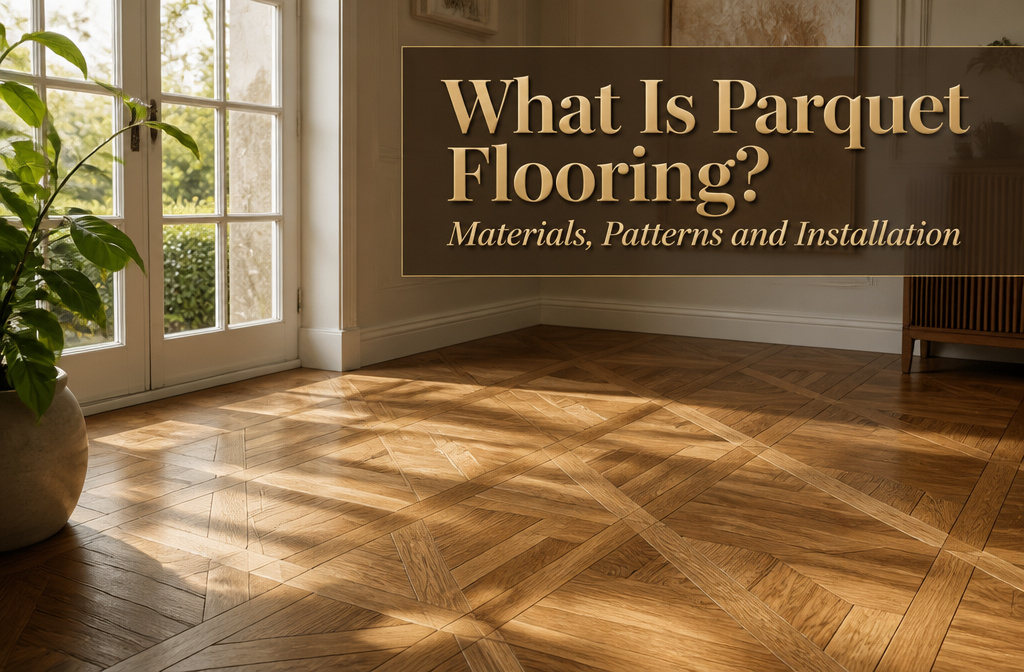

Parquet flooring is wood built from small geometric pieces fitted into patterned tiles. The catch is that moisture warps the blocks, so basements and bathrooms are out unless you spring for engineered construction. Oak dominates the market because it stains evenly and holds up under all those angled cuts, but the real budget split is between $3 DIY tiles and $45-per-square-foot custom work pieced by hand.
What Parquet Flooring Is
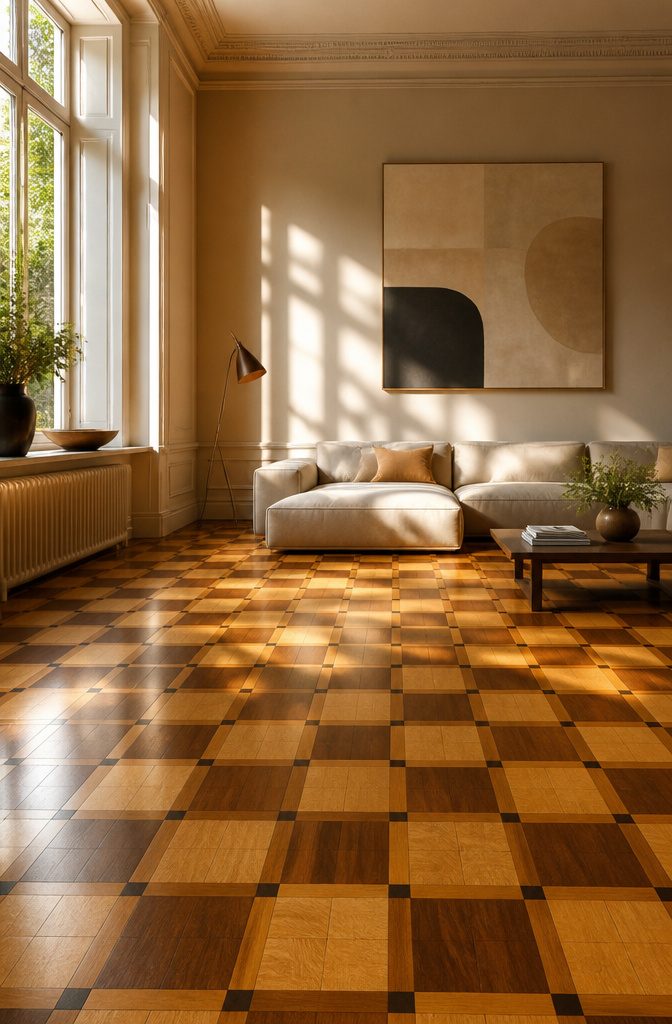
Parquet flooring is wood flooring built from small pieces cut into geometric shapes and fitted together. The word itself comes from the French "parquetry," meaning small compartment, and the technique took shape in France during the late 1600s. Artisans would cut and fit each piece by hand, then glue the assembled pattern directly to the subfloor.
King Louis XIV had the marble floors at the Palace of Versailles pulled up and replaced with what became known as "parquet de menuiserie" around 1684. Marble needed constant washing, and all that water was rotting the timber joists underneath. The new wood floors weighed far less and were easier to maintain, which solved the structural problem while giving the palace its famously intricate look.
Because every plank was laid by hand, these floors stayed exclusive to wealthy households and public buildings for the next two centuries. The skill and time involved made parquet a status symbol, not a standard option.

Nexus Vinyl Tiles: Refresh your home for a low cost and no hassle with the Nexus Vinyl Floor Tiles. Our tiles can be used in any room in your home including the kitchen, dining room, bedrooms, bathrooms, foyers, and basements. No messy glue or adhesives needed. Includes 20 vinyl tiles.

Nexus Vinyl Tiles: Refresh your home for a low cost and no hassle with the Nexus Vinyl Floor Tiles. Our tiles can be used in any room in your home including the kitchen, dining room, bedrooms, bathrooms, foyers, and basements. No messy glue or adhesives needed. Includes 20 vinyl tiles.
What It Is Made Of
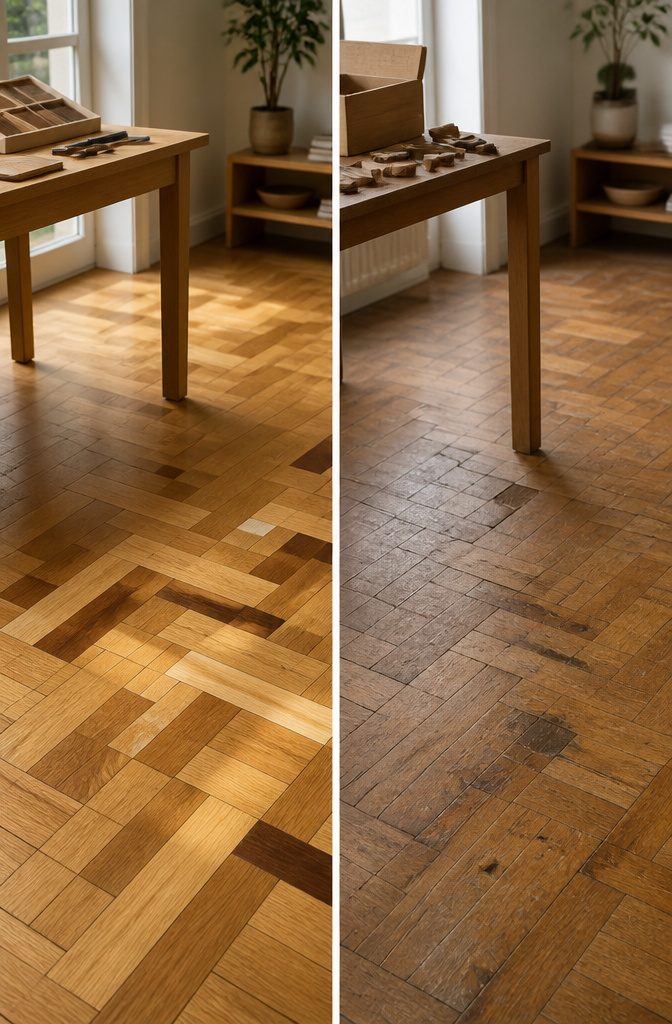
Parquet flooring starts with the same hardwoods you’d find in any traditional plank floor. Oak dominates the parquet market because it takes stain well and holds up under the geometry of small pieces, but maple and walnut are common alternatives if you want something lighter or with a darker, more dramatic grain.
The real choice is between solid and engineered construction. Solid parquet is blocks of hardwood through and through, so it can be sanded and refinished repeatedly over decades. Engineered parquet layers different wood types for stability, with a hardwood veneer on top. It handles humidity and temperature swings better, which matters in older homes or over concrete subfloors.
Parquet arrives as tiles rather than individual strips nowadays. These tiles range from 5/16 inch to 3/4 inch in total thickness, with a mesh or thin skeletal backing holding the hardwood pattern together. That backing is what makes a weekend installation plausible.

Timeless Elegance: Parquet flooring adds a touch of sophistication and warmth to any room with its intricate patterns and rich wood tones.

Durable Construction: Crafted from high-quality parquet wood for long-lasting beauty and resilience.

Patterns That Define It
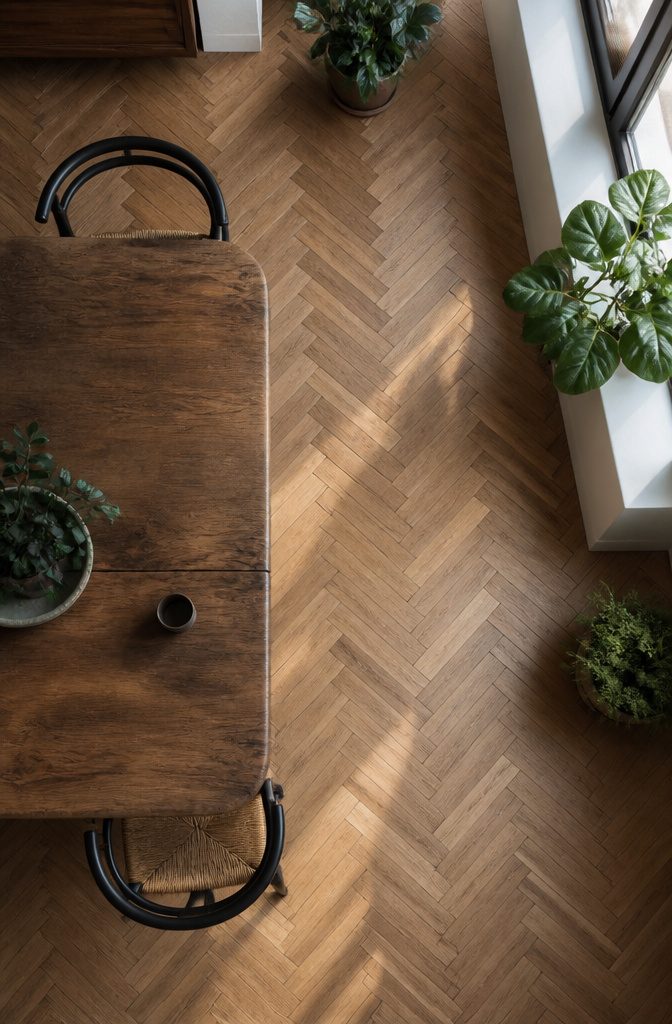
The real difference between parquet and any other wood floor is the geometry. Herringbone is the one you see everywhere now: short rectangular blocks laid in a zigzag where each piece butts against the next at a 90-degree angle. The ends stay blunt, so the break between pieces creates a subtle stair-step rhythm. Chevron looks like a cousin at first glance, but those plank ends are cut at 45 degrees, so two slants meet to form a clean, unbroken V. It reads sharper and more directional; herringbone feels a little older, a little softer.
Basket weave is what it sounds like: groups of parallel slats turned 90 degrees between blocks so the whole floor looks woven. This is the classic 12-by-12 parquet tile format, and it reads as formal and symmetrical compared with the movement in herringbone. Versailles is the showpiece: interlacing diagonals within a border frame, the pattern King Louis XIV commissioned to replace marble at the Palace of Versailles. It is ornate, heavy, unmistakably French.
Each pattern carries a different visual weight. Herringbone and chevron pull the eye forward; basket weave and Versailles hold still. Choose based on whether you want the floor to move or to anchor the room.

Wood inspired peel and stick floor tiles with a parquet design

100 % Waterproof Rigid Core Vinyl – Engineered ISOCORE construction ensures full water resistance for kitchens, bathrooms, basements, and laundry areas, with no acclimation required before installation.

Elegant design: Parquet flooring adds a touch of sophistication and warmth to any living space.
How It Gets Installed
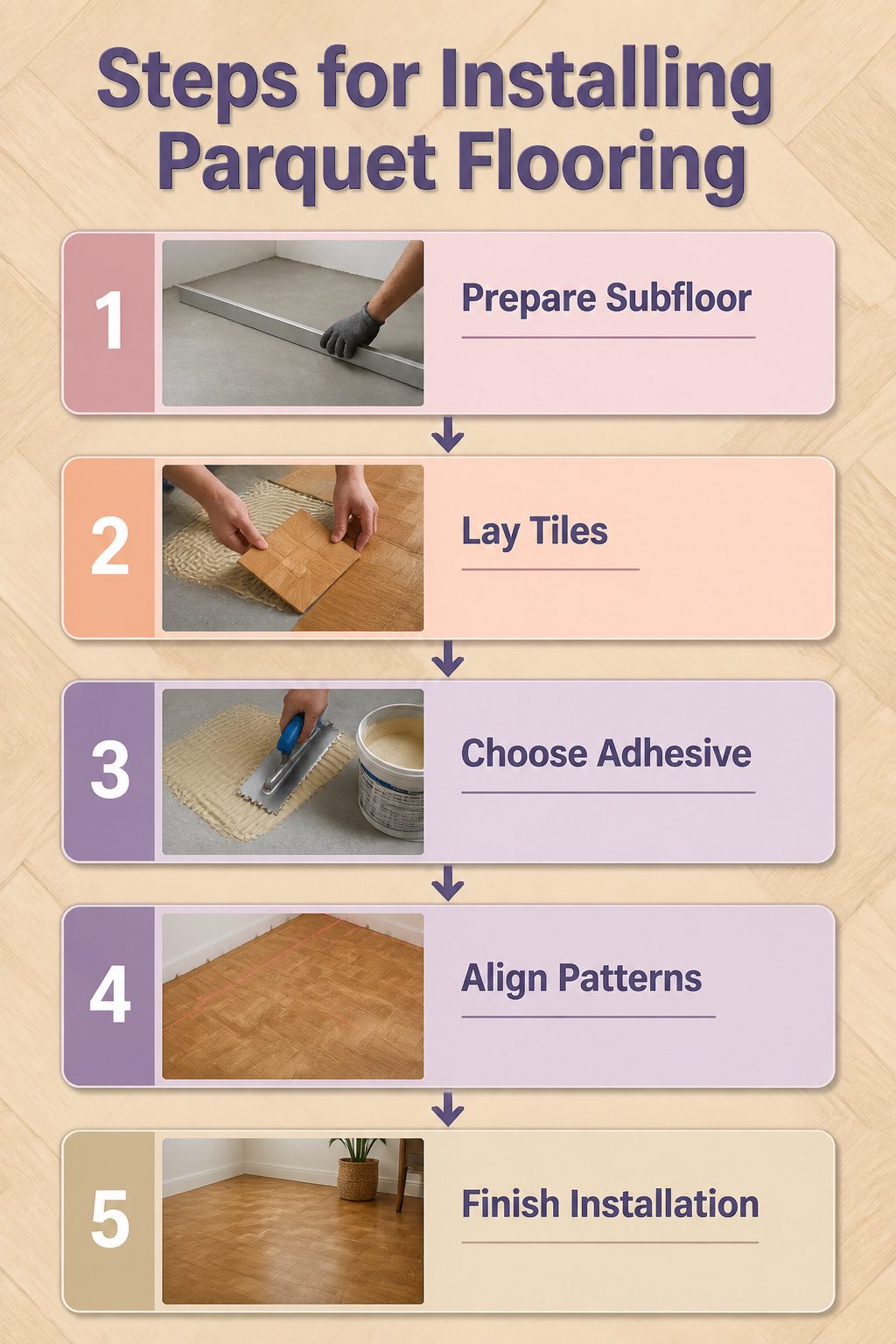
Most parquet today arrives as tiles with the small strips already bonded to a backing, which changes how it goes down. The three methods are glue, nails, or staples straight into the subfloor. I have watched enough flooring jobs to know that a stable, dry, level subfloor is the part you cannot skip; an uneven surface lets tiles rock or work loose over time.
Solid or engineered parquet laid piece by piece is where professionals earn their fee. The pattern has to repeat perfectly across the room, and walls that are not square will throw the alignment off fast. Parquet tiles are the friendlier DIY route. They are lighter to handle, the pattern is already set, and you are basically laying a grid rather than fitting individual strips. That said, the glue type and trowel notch size vary by brand, so the carton instructions are the only guide worth following. I would budget a weekend and a helper, but I would not promise a first-timer the same result as a crew that has done it a hundred times.

Miele XL Parquet Twister Floorhead: For gentle and effortless cleaning of hard flooring, this attachable Miele vacuum cleaner head makes cleaning your home easy

🏠DETAILS: 15.8x78.8 Inch, total 8.65 sq.ft (40cmX2m) Made of durable thin vinyl, thickness: 0.015 In (0.4MM). Peel and stick wood planks vinyl flooring roll, brown shiplap planks color. Waterproof. Removable.

[Ultra-realistic Surface Texture Restoration]: Realistic texture and a durable surface with excellent wear resistance; the surface won't scratch easily, doesn't retain stains, and is easy to clean.
Keeping It Looking Good
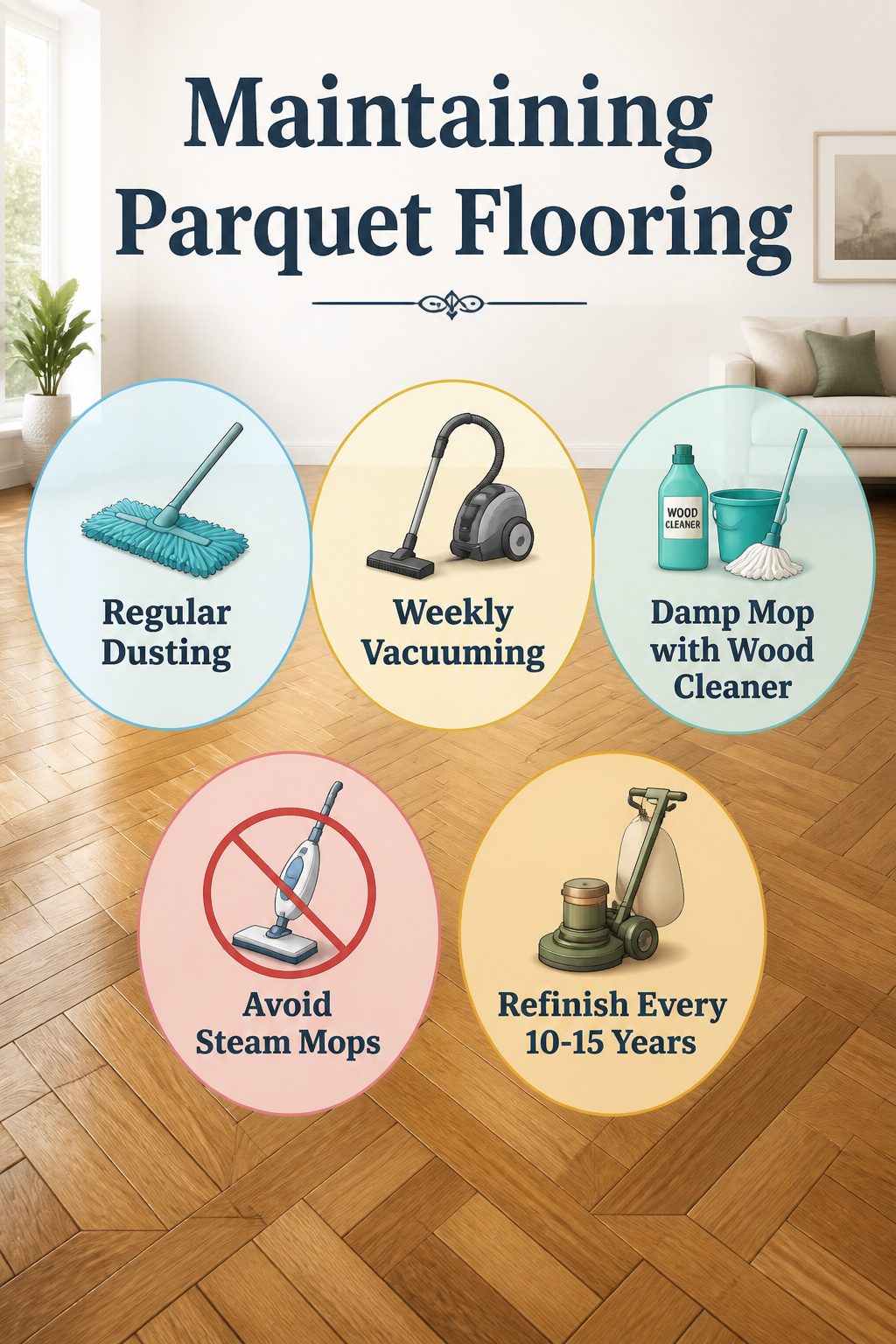
Parquet floors don’t ask for much, and that’s exactly why I lean toward them over carpet in a busy house. A quick pass with a microfiber dust mop every few days pulls up the dust and pet hair that would otherwise settle into fibers. Run a vacuum with a brush attachment once a week, and you’re already ahead of the game. When the floor needs more, a damp mop with a cleaner made specifically for wood does the trick. Skip the steam mop, though. The heat and moisture seep into seams and swell the grain, which is a repair you don’t want.
For anyone fighting allergies, this matters: parquet holds none of the dust mites, dander, or pollen that carpet traps. The smooth surface lets you actually remove what’s there instead of just stirring it up.
Even with good care, the finish wears thin in high-traffic spots after a decade or so. Refinishing every 10 to 15 years brings the luster back, though I’d hire a pro for it. Sanding across grain directions in those geometric patterns is painstaking work, and cross-grain marks show up from across the room.

3in1 Vapor Barrier Underlayment | 500 sq. ft bundle (5 rolls each 100 sqft)

Large Area Coverage: This floor underlayment covers 100 sq. ft / 9.3 ㎡ per roll (333.46 x 43.31 x 0.08inch / 8470 x 1100 x 2mm). Ideal for large installations, it reduces construction time and material waste for quick, efficient flooring completion

Large Area Coverage: This floor underlayment covers 100 sq. ft / 9.3 ㎡ per roll (366.14 x 39.37 x 0.12inch / 9300 x 1000 x 3mm). Ideal for large installations, it reduces construction time and material waste for quick, efficient flooring completion
Where It Works Best
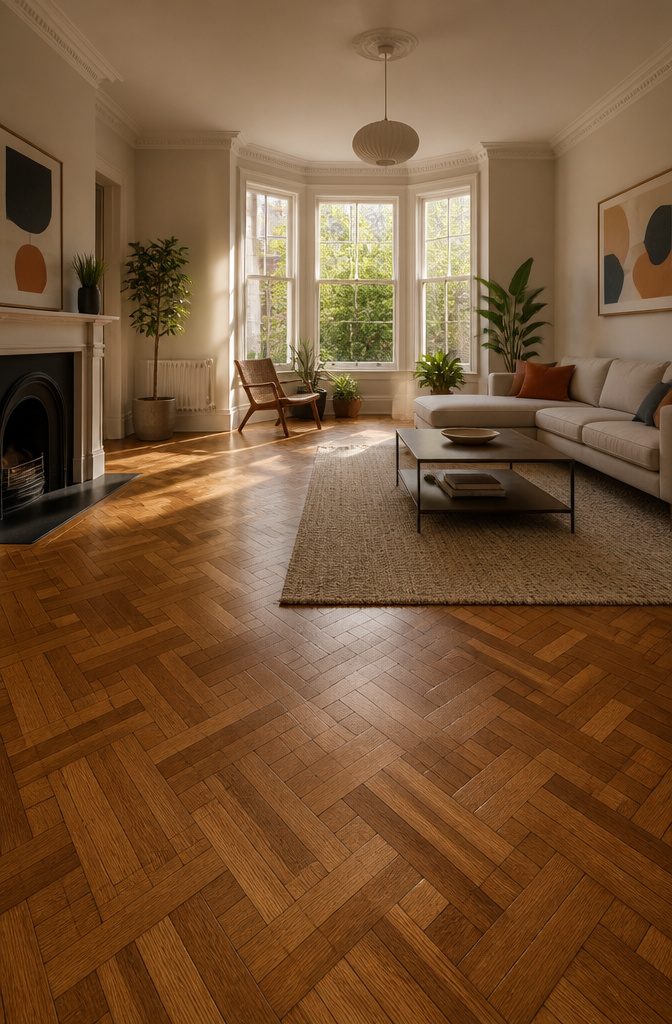
Parquet does not belong in bathrooms or basements. Wood, even in tile form, warps and rots where moisture sits, and the geometric patterns collect humidity at the seams.
Everywhere else, it earns its keep. I’ve run it in high-traffic living rooms and dining rooms without issue, and engineered parquet pairs cleanly with underfloor heating systems. Solid hardwood versions handle it less gracefully, so that specification matters if radiant heat is part of your plan.
The look itself narrows the field. Those bold geometric patterns read as busy in small or starkly modern spaces, and some buyers see the style as dated. It thrives where warmth and character are the brief, not where minimalism is the goal.

Nexus Vinyl Tiles: Refresh your home for a low cost and no hassle with the Nexus Vinyl Floor Tiles. Our tiles can be used in any room in your home including the kitchen, dining room, bedrooms, bathrooms, foyers, and basements. No messy glue or adhesives needed. Includes 20 vinyl tiles.


You will receive peel and stick Vinyl Floor Coverings with a wood parquet pattern.
The Trade-Offs
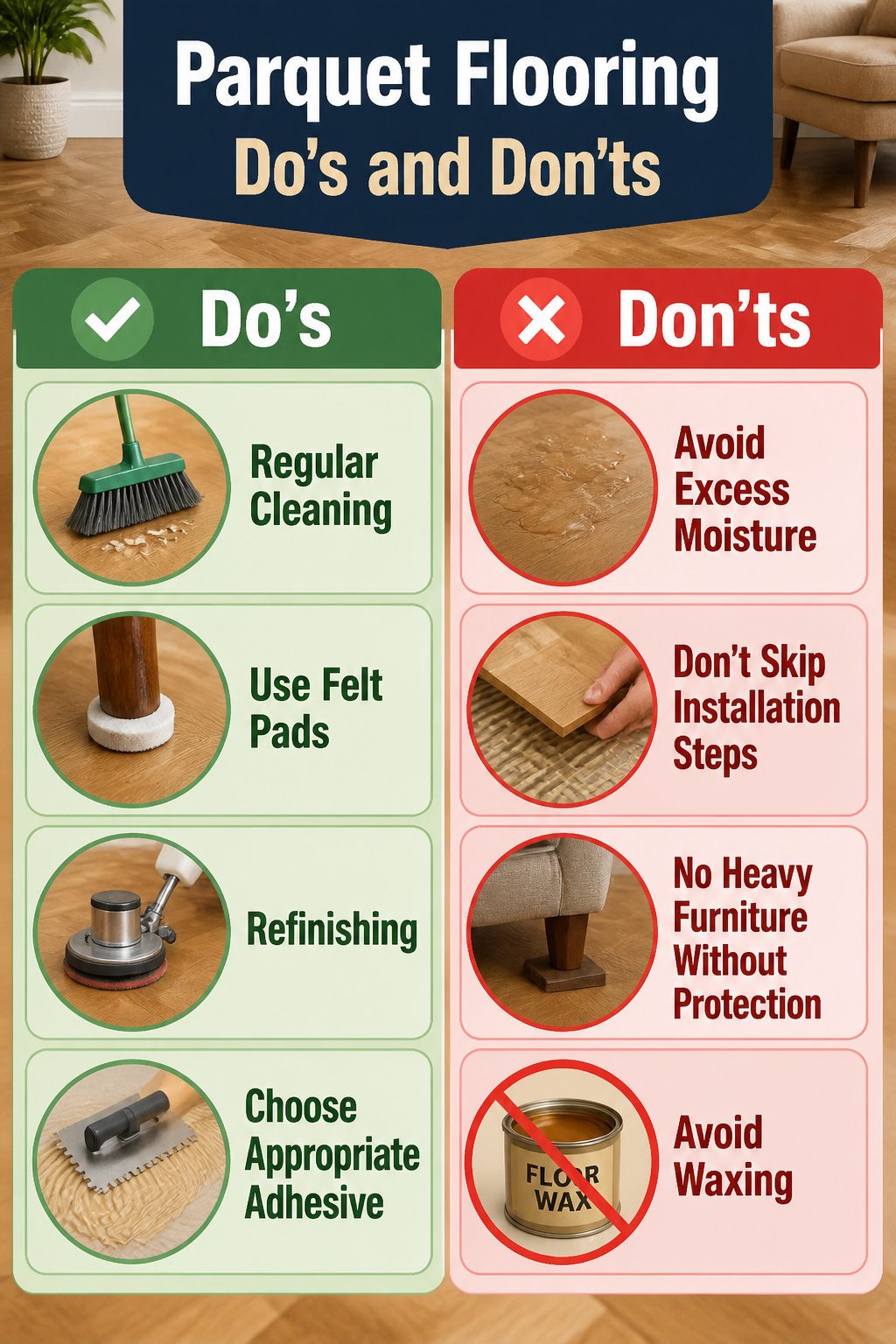
Parquet flooring holds up for decades if you treat it right, and the geometric patterns still stop people at an open house. Dust and pet hair sweep right off, which matters a lot if you are sneezing through spring in a carpeted rental now. The hardwood surface does not trap allergens the way fibers do.
The catch is that moisture will warp the blocks, so basements and bathrooms are out unless you are looking at engineered options. Installation is not a Saturday project for most of us; the precise cutting and pattern matching usually means hiring someone skilled, and that drives the price up fast. Even after it is down, chair legs and excited dog nails leave scratches you will notice.
I think parquet pays off only when you are staying put long enough to enjoy it yourself. The resale bump exists, but only if the style reads as classic rather than busy to whoever walks through. Small rooms can feel overwhelmed by the geometry, so the scale of the pattern matters as much as the wood species.

Durable Construction: Crafted from high-quality parquet wood for long-lasting beauty and resilience.


Dimensions: DIN A4 (8.2 x 11.6 inches)
Solid vs. Engineered
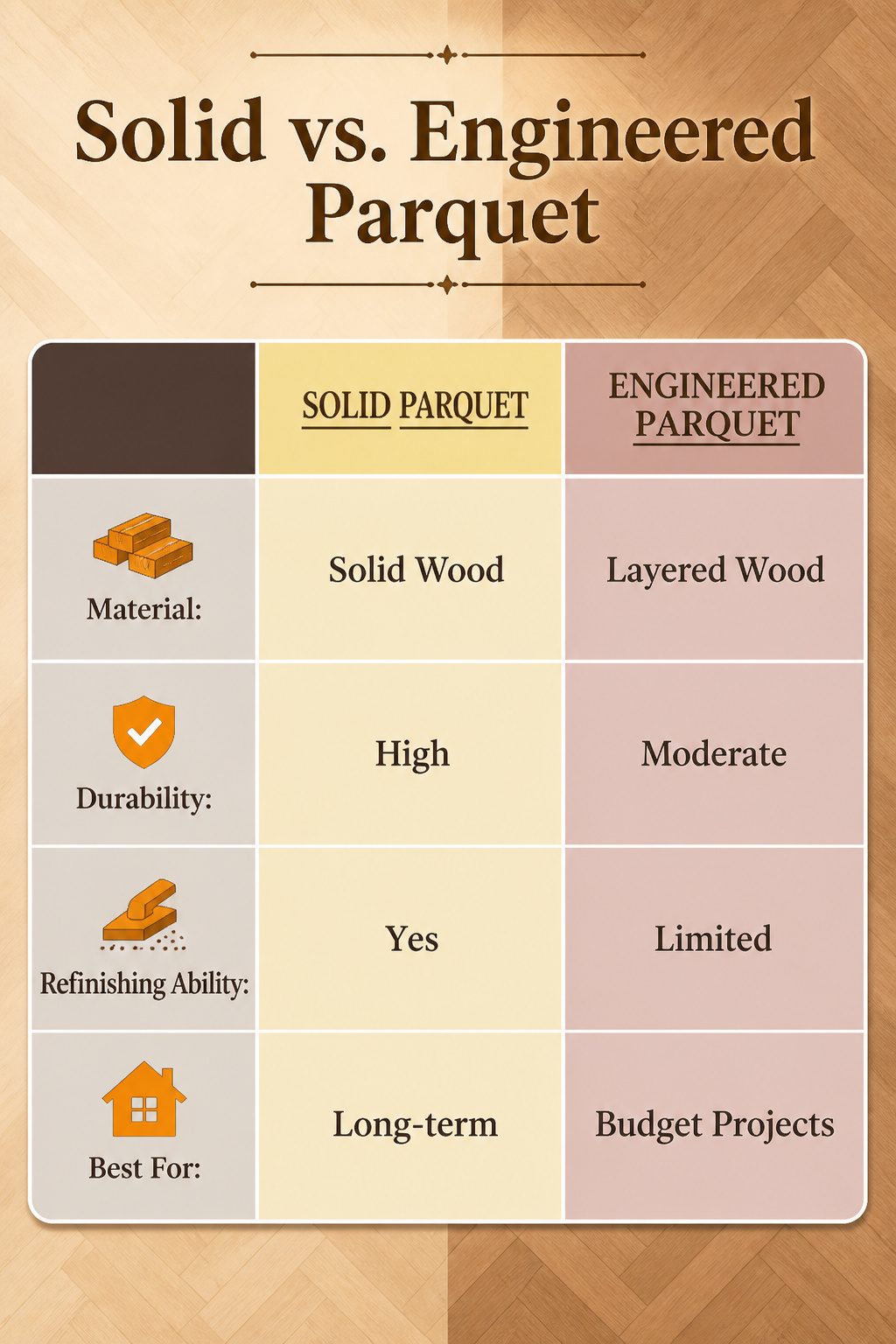
Solid parquet is exactly what it sounds like: blocks of solid wood attached together. You can sand it and refinish it many times over, which makes it the long-haul choice if you are staying put. Engineered parquet, on the other hand, layers different wood types with hardwood on top. That layered build makes it more stable when humidity swings or temperatures shift, which matters in older rentals or any place with moody climate control.
Both come in the same species, oak to walnut to cherry and even exotics like teak or mahogany. The grain and color read nearly the same once the floor is down. For a renter or a first-home owner weekend-projecting on a tight budget, engineered usually wins: it handles the real conditions of your space without demanding perfect stability underneath.

Elegant design: Parquet flooring adds a touch of sophistication and warmth to any living space.

Elegant design: Parquet flooring adds a touch of sophistication and warmth to any living space.

Elegant Aesthetic: Parquet flooring offers a timeless and sophisticated look to elevate any interior space.
What It Costs
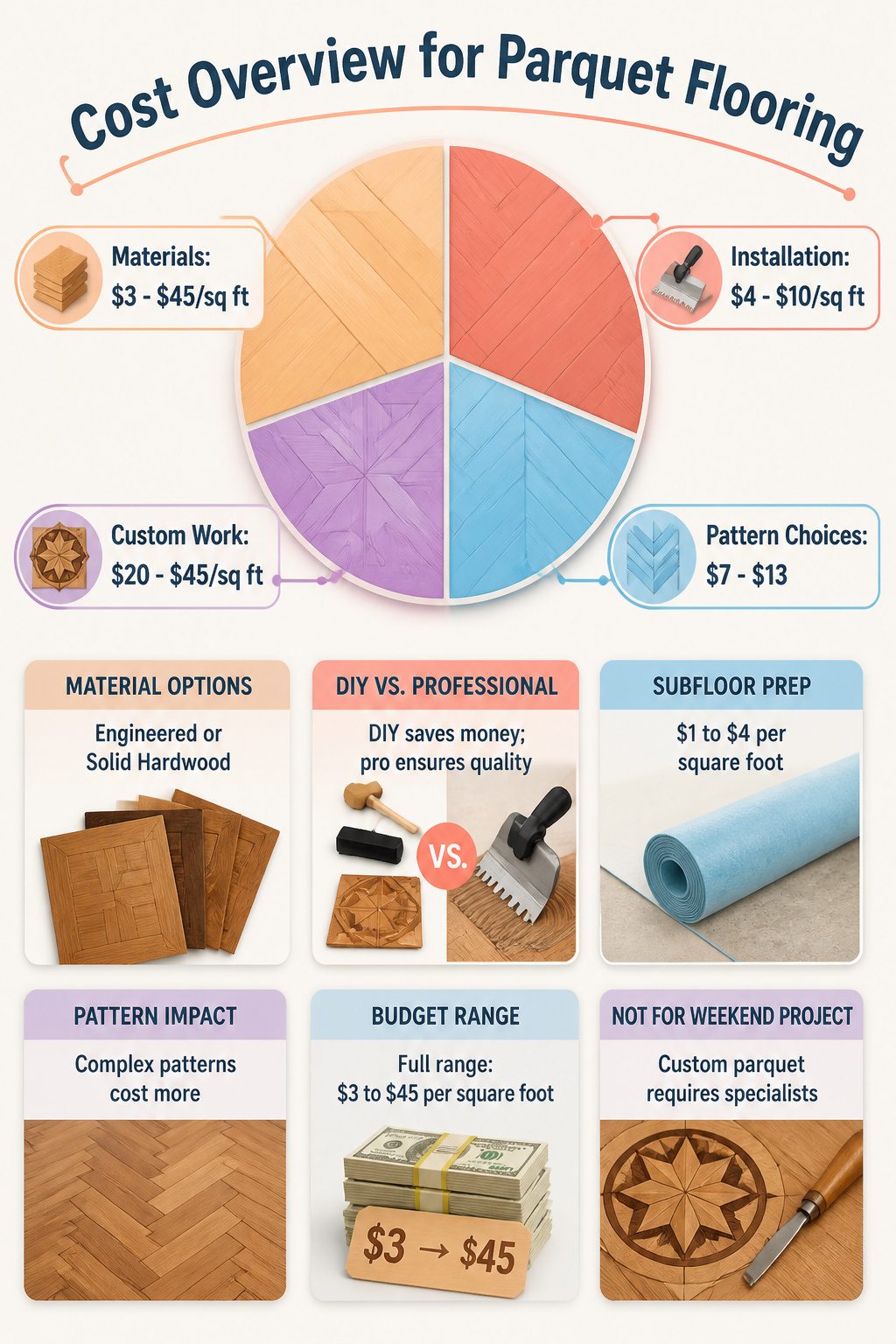
The full range for parquet flooring runs from about $3 to $45 per square foot, and where you land depends almost entirely on whether you’re willing to lay it yourself. Engineered parquet tiles, the kind sold in 9-, 12-, or 18-inch squares and bonded to a mesh backing, start around $3 to $5 per square foot for materials alone. Those same tiles professionally installed push you toward $7 to $10 per square foot. Solid hardwood parquet costs more upfront, $6 to $9 for budget options up to $14 to $22 or more for premium species, and installation runs $4 to $6 for simple tile patterns, climbing to $7 to $10 for standard professional work.
The real budget killer is pattern choice. Herringbone and chevron demand skilled labor and extra material waste, running $7 to $10 for basic installation and $9 to $13 or higher for mid-range work before you even look at custom work. Custom parquet, still pieced together like a puzzle by specialty shops, sits at $20 to $45 per square foot and belongs firmly outside a weekend-project budget.
For the renter or first-home owner doing one room with a Saturday and a helper, the entry point is those engineered tiles at $3 to $5, keeping total project costs under $1,000 for a typical bedroom. Add professional installation for anything complex; subfloor prep alone runs $1 to $4 per square foot if you need it, and skipping that step to save money usually means creaking and hollow sounds within a year.

𝐏𝐫𝐞𝐦𝐢𝐮𝐦 𝐕𝐢𝐧𝐲𝐥 𝐅𝐥𝐨𝐨𝐫𝐢𝐧𝐠 𝐑𝐨𝐥𝐥: Engineered with a robust 1mm thickness, this premium vinyl roll is significantly more durable than standard decorative stickers. Weighing a substantial 3.0 lbs, this heavyweight construction ensures the material stays flat and provides a high-quality, professional finish that stands up to the daily traffic of a busy home
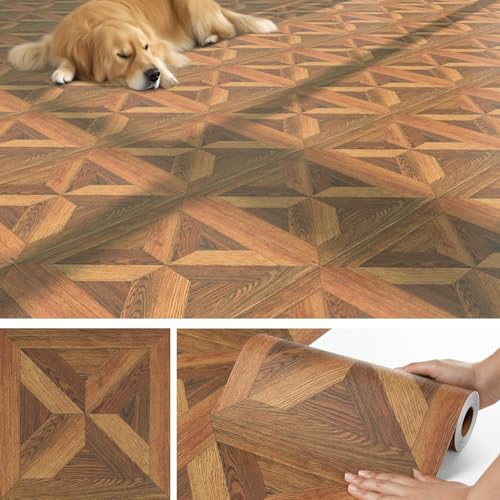
🏠 Vinyl flooring roll: Thickness is 0.045inch (1mm). Size 12x47 inch included 4 tiles (12x12") connected, total 4 sq.ft, made of vinyl. Roll sheet vinyl flooring wood tiles, Waterproof, Removable, Thick.

Stylish - Authentic wood looking and grain texture, adding timeless feature for your home
Frequently Asked Questions
What is parquet flooring?
Parquet flooring is wood flooring built from small pieces cut into geometric shapes and fitted together. The technique took shape in France during the late 1600s, when artisans cut and fit each piece by hand before gluing the assembled pattern directly to the subfloor. Today it arrives as pre-assembled tiles with a mesh or backing that holds the hardwood pattern together, making installation far more accessible than the original hand-laid method.
What are the pros and cons of parquet flooring?
Parquet lasts for decades with proper care, sweeps clean of dust and allergens better than carpet, and adds visual character that still draws attention. The downsides are real though: moisture warps the blocks so basements and bathrooms are poor choices, installation usually requires skilled labor that drives up cost, and the geometric patterns can read as busy or dated in small or minimalist spaces. Scratches from furniture or pets also show up clearly on the patterned surface.
How do you clean parquet flooring?
Run a microfiber dust mop across it every few days and vacuum with a brush attachment weekly. When it needs deeper cleaning, use a damp mop with a cleaner formulated specifically for wood floors. Avoid steam mops entirely; the heat and moisture penetrate the seams and swell the wood grain, which leads to damage you cannot easily reverse.
Is parquet flooring suitable for all spaces?
It works well in living rooms, dining rooms, and bedrooms, but keep it out of bathrooms and basements where moisture accumulates. Wood warps and rots where water sits, and the geometric seams trap humidity. Engineered parquet handles underfloor heating better than solid hardwood, so check your construction type if radiant heat is part of your plan.
How much does parquet flooring cost?
Materials and installation together range from about $3 to $45 per square foot. Engineered parquet tiles start around $3 to $5 per square foot for materials alone, with professional installation pushing that to $7 to $10. Solid hardwood parquet runs $6 to $22 or more for materials, and intricate patterns like herringbone or chevron demand extra material and skilled labor that pushes costs toward $9 to $13 or higher. Custom parquet pieced together by hand sits at $20 to $45 per square foot.